The three tensions
The master choice is not made in the abstract. It gets made in three places, every time you put a real piece of work in front of an agent.
Picture them as three settings on the boat, your domain of control, that you navigate through the current.
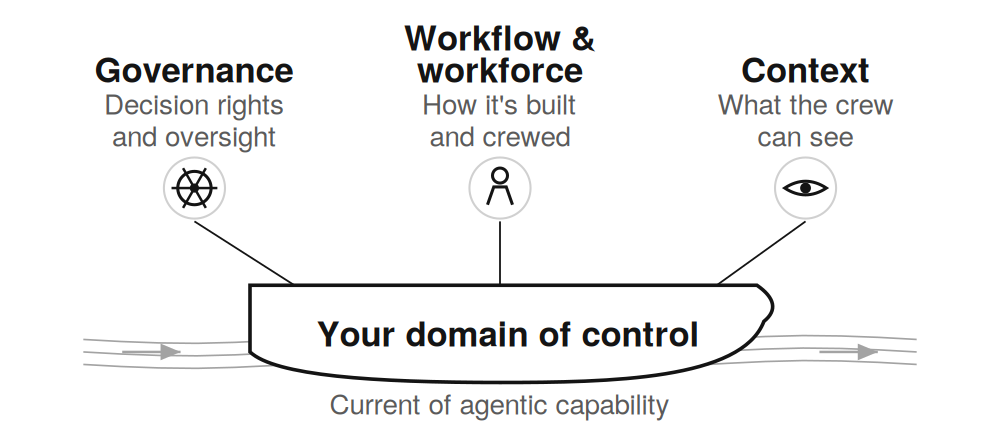
They are set together, all three at once, with no correct order between them. Every piece of real work needs all three considered.
Workflow and workforce. How the work is built and who, or what, staffs it. Do agents take existing seats in the existing workflow, or do you redesign the workflow and the roles inside it together? One end slots agents into the organization you already have. The other reshapes the organization around what humans and agents can do together.
Context. What the crew can see. How much organizational knowledge you hand the agents, and how far it reaches: inside one function, across the enterprise, or out to partners and customers. The uncomfortable part is that the context you own and the organizational influence you hold turn out to be nearly the same thing, which is what makes handing it over feel like giving something up.
Supervision, autonomy and governance. The decision rights aboard the boat, and what catches a bad call before it does damage. How much the agent does without a human in the loop, and whether your guardrails are bolted on after the fact or built into how the work runs. Autonomy without governance is reckless. Governance without autonomy is theater.
Where the tensions meet the water. Each tension is set inside your organization, but what it costs to set it is decided outside. Whether agent output can be sent as it stands, whether the software you run will let an agent operate it, whether a rule bolted on afterwards holds: those move in public, month by month, and they move for everyone at once. The River tracks twenty of them under these three headings and records how each one moved. The River →
Each tension is worked in full, with the cases behind it, in Chapters 4, 5 and 6 of The River Doesn't Wait. About the book →